
Menu
Hebrew Handwriting and Rashi Script
Besides the "square" script, we have, of course, a handwriting script:
Same phrase written in different scripts:
| Modern "square" script | היום קצר והמלאכה מרובה |
| היום קצר והמלאכה מרובה | |
| Handwriting: |
היום קצר והמלאכה מרובה |
The whole alphabet written in handwriting script (including the final letters):

א ב ג ד ה ו ז ח ט י כ ך ל מ ם נ ן ס ע פ ף צ ץ ת ש
See also the Table of Scripts.
How to write
ה
|
ד
|
ג
|
ב
|
א
|
י
|
ט
|
ח
|
ז
|
ו
|
ם
|
מ
|
ל
|
ך
|
כ
|
פ
|
ע
|
ס
|
ן
|
נ
|
ר
|
ק
|
ץ
|
צ
|
ף
|
ת
|
ש
|
Most letters are written within the boundaries of the line, but some letters go below or above the line. (Note that in the square script, Lamed is the only letter that extends above the line. (A Hasidic tale says that Lamed calls you to Learn—לְמַד!)
Most often, the final versions of letters in the handwriting script are longer. This gave another name to the final form of the letters: in Yiddish they are called lange Khof, lange Nun, and so on (lange is Yiddish for long; with the exception of the final mem, which was called in Yiddish shloss mem - a closed/locked mem). Other letters (Tet, Lamed, final Fei, both Tzadi, in some handwritings - also Alef and Vav) extend above the line.

Other scripts
There are two other types of script (or fonts) used in traditional books.
Rashi script כתב רש"י

16th-century depiction of Rashi
(from Wikipedia)
Rashi script, named after Rabbi Shlomo Yitzchaki (Solomon son of Isaac, שלמה יצחקי, abbreviated as: ר"שי), famous as the author of the first comprehensive commentaries on the Talmud, Torah, and Tanakh (Hebrew Bible). The script is mainly used in rabbinical literature, primarily to write the commentaries of Rashi himself. This script is considered to be the prototype of the handwriting script.

See also the Table of Scripts.
STaM Script כתב סת"ם
Also called a Sofer script. The name of the STaM script comes from the words Sefarim, Tefillin, and Mezuzot ספרים, תפילין, מזוזות, i.e., Books (traditional books, like Torah scrolls or Esther Scroll, or other books being read in synagogues; a regular book can be printed with any script, of course), Tfillin and Mezuzot. Texts that are not just traditional but have ritual meaning and must be written properly with the proper script on specially prepared parchment. The script includes special "crowns" (תגין, כתרים) on the letters. There are three or so types of this script: Beit Yosef, Ari, etc.

A sample of Stam inscription, inscripting Shma Israel
for a Mezuzah (Beit Yosef version of Stam.)
See also the Table of Scripts.
Also, through the ages some calligraphic techniques were developed to either make the text to look more beautiful, to save space on the page, or to integrate the text into the ornament. Most popular and famous is the Alef-Lamed ligature (U+FB4F).


Alef-Lamed ligature

A "longer" letter Hei
The Ancient Hebrew Script כתב דעץ
Known as the ancient Hebrew script (Phoenician, Paleo-Hebrew, or Western Semitic). Historical/archeological findings track it down to the 16th-19th centuries BCE; it was most probably invented by the neighbors of the Israelites—the Phoenicians. The Jews stopped widely using it around the 5th century BCE. The Samaritans use a variation of this script to this day. Also, sometimes it is used in Israel when they want to provide an illustration of an ancient heritage. The last historical usage of this script was in Bar-Kokhba coins, minted in the 2nd century CE.

This modern 1 shekel coin depicts an ancient
coin from 6-4 centuries BCE. The back side
of the coin contains an inscription יהוד, written
with ancient Hebrew script (and according to
the ancient orthography rules; today we'd
write it as יהודה.)
The picture is taken from
the web site of The Bank of Israel.
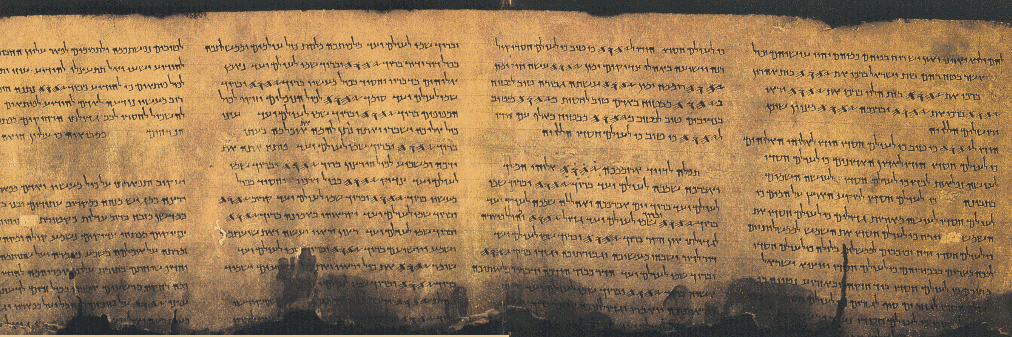
From the Habakuk Scroll (Haarmann 1990:311)
Dead Sea scrolls were written with a modern
(square) script. The Name of the God is written
with the ancient script though.
See also the Table of Scripts.